
The High-Energy Balance: Lessons on Yin, Yang, and Staying Whole
Why "Average is not safe" and how to build a discipline that supports your life instead of crushing it.

Welcome to the Dōjō. To find specific technical drills or philosophy essays, visit our Master Index. Full access to our Japan-grade masterclasses and technical archives is reserved for our Premium Members.
Hello, how are you doing? 👋
I hope you've enjoyed my latest posts and videos!
Today I'm sharing an article that I think is essential. Both in and out of the Dōjō.
Indeed, I firmly believe that it contains elements that truly have the potential to enlighten and support your journey through life and Karate.
In it, I share lessons I've learned through life experience, the teaching of my Sensei, and long periods of training in Japanese Dōjō.
Please take the time to read it calmly and quietly.
I hope you’ll enjoy it!
With all my respect and appreciation.
OSS!
Nicolas
I wrote these few following words some years ago, as I was going through a very tough and painful period of my life. I was trying to reconnect myself to the me I really was, the me I had begun to find during my first and most intense training trip in Japan which lasted one year. The real me, the strongest me.
“While I was experiencing
some tunnels of darkness
with life and training
in Japan,
long time ago,
My Sensei used to tell me…
Find your balance and
make a simple and happy life.
In training as in life,
everything is a matter of balance.
Never stop your practice but
manage to feel comfortable
on a daily basis.
Make it useful,
as a great tool to improve
yourself and your life.
But focus your mind and heart
on what is important.
Genuinely.
Make and appreciate simple things,
always.
You will grow as a martial artist,
as a Human being.
Do not push yourself too much
because
you know how sometimes it can be
uneffective…
But find your balance
between all the important areas of your life.
Dedicate yourself
to discovering YOUR own and unique way,
to building the life that really fits you.
YOUR life.
Build valuable connections.
Both in life and Dōjō,
you will experience many changes
that will fullfil your heart
and spread around you.
Do not split your life.
All is whole.
Karate is everything.
Everything is everything
One.”
This first training trip in Japan, which is now more than 20 years ago, lasted an entire year. It was really awesome and I was feeling like a fish in the water in this beautiful country. Training was fantastic, people were wonderful and I met there my best friends in life. But everyday life hasn’t always been what you could call easy for me.
I sometimes experienced periods of - controlled - sadness, periods of nostalgia about my country and friends over there - Maybe because of the language which always required tremendous efforts for me to understand what people were talking about, or my fatigue caused by very hard training, or the feeling of scarcity around money and food, or my lack of confidence to go out and meet girls, or all of that together.
I’m a very emotional guy, and that’s especially true when I’m going through a hard and intense training period. In fact, it always happens when I begin to feel deep changes within myself, when I feel a new kind of power growing inside me and which is the direct consequence of my - sometimes painfull - dedication to training. In that kind of period, feelings always overflow within me and I see the world through a veil of highly intense emotions, and often through tears… This is what I call “controlled” sadness. It’s not sadness about my condition, nor about me, but it’s some kind of very deep and intense feelings around things that makes me feel melancholy. This can be caused by almost anything that comes to me in life: witnessing some sort of injustice, seeing someone who is in a very bad state, in precariousness or who is facing very hard difficulties, seeing a child who misses his parents… It’s in fact a very deep kind of empathy.
“If you search for awakened heart, if you put your hand through your rib cage and feel for it, there is nothing there except for tenderness. You feel sore and soft, and if you open your eyes to the rest of the world, you feel tremendous sadness. This kind of sadness doesn’t come from being mistreated. You don’t feel sad because someone has insulted you or because you feel impoverished. Rather, this experience of sadness is unconditioned. It occurs because your heart is completely exposed...
For the warrior, this experience of sad and tender heart is what gives birth to fearlessness...
Real fearlessness is the product of tenderness. It comes from letting the world tickle your heart, your raw and beautiful heart. You are willing to open up, without resistance or shyness, and face the world. You are willing to share your heart with others.”
Excerpts from “Shambhala: The Sacred Path of the Warrior” by Chogyam Trungpa
Faced with this kind of periods, I’ve always made the choice to embrace all these strong feelings that were growing within me, to feel them fully for what they are: my inner signal, my color, the words I speak to the universe. Being aware and appreciating my feelings this way helped me a lot to cope with the harshness of the training, to return to the Dōjō every day even though I was very scared, and to truly enjoy the beauty of the gifts that life offers us.
This is a very valuable lesson I learned over there, Always put the feelings first.
Since I know it can be a real game-changer in life - to help you unlock your potential and build the life of your dreams, I will surely come back to it for you in more detail in a future article. Stay tuned!!! 😉
I went to train in Japan because I felt that it was a kind of duty for me. As soon as I started practicing Karate in France, I thought that if one day, I wanted to be legit and fair when talking about this great art, I would first have to train in Japan for an extended period and with the best and fierce Sensei(s) over there.
Average is not safe.
I’m like this, I can’t practice something and stay average. It’s not like I always want to be the best - life taught me quite harshly that it was impossible to be the best everywhere, but I’d rather not do something than just casually practice it and not feel like I’m starting to achieve some sort of mastery.
As an example,
A few months ago, I started skateboarding again - after more than 20 years without doing so - to support my son in his learning process and spend quality time with him. And it’s stronger than me, I can’t just ride around lightly with my board, I have to learn advanced moves and tricks, know exactly how and where to put my feet on it, understand an feel its physic… So we started watching videos, taking notes, rehearsing moves over and over, and practicing seriously every day.
So for Karate it was the same. I truly fell in love with this art as soon as I made my first steps in a Dōjō, and I wanted to achieve a certain skill level, always keeping in mind the classic and naive image of the “old master in the mountains” promoted by the martial art movies and TV series of the 70s and 80s.
I was not good… And I still am not. But it was my thing and since I loved it, I’ve been able to dedicate my time and heart to its practice, always putting Karate first in my life and before everything else - truly everything. The kind of commitment I could never make to things I didn’t really enjoy like school, work etc… I always need to really be exalted about something to commit to it.
I think that whatever your thing is, staying in the average zone is not safe for your well-being and mental health. Knowing that there’s more, that there’s a fulfilling path of learning, a blissful mastery that is within your reach, and not take it is like loosing a battle with yourself. Not being able to find the courage and dedication to build up a discipline to practice can only lead to great frustrations and regrets in life.
That’s why since my childhood my motto in life has always been “Always make your choices and actions today so that you won’t regret them tomorrow“.
So I devoted myself a lot to Karate.
I trained more than most people and continue to maintain that regime today.
I pushed myself a lot for Karate, in all areas of my life. I mean really a lot, so much that many people - even in Japan - thought that I was a bit crazy and fanatic. And surely I was!
So at this time - and it was understandable - I was really thinking that…
Balance is for losers!
And even if we physically can’t do it anymore, when we’re sick or when we’re going through very tough life experiences, we must still continue to train. I was educated like that in my practice of Karate. A mindset that has been reinforced, especially in big cities like Tokyo, by today’s hustle culture.
I thought people who talked about creating a balance between their “private” life and the Karate training were just losers! When they said they couldn't attend training due to family commitments, I just thought they were making excuses and being weak.
I understood later that it was simply… not my business! And I just didn’t know what was going on in their lives, what their battle were and the puzzles they had to solve… In fact, they were the only ones walking in their shoes, and as sovereign individuals, they were the only ones qualified to decide what was the right way to practice for them.
Everyone can practice a martial art in their own way that suits them best, there is no room for competition when you practice an art whose purpose is to improve your well-being and quality of life. And of course, what really mattered was how they were showing up in the Dōjō!
And for each individual the most important thing is that the way you practice and your level of dedication match your own words, thoughts and training expectations.
For me it was training, training and more training, a real “Never Give Up” spirit that often was - literally - the synonymous with blood and tears. By doing this, I was truly able to be accepted and taught in the Japanese Dōjō - which, as a Gaijin, was not really easy to achieve at that time -, and as a reward, I learned a lot about myself, people, life and… The Way.
But even if this spirit almost saved my life on certain occasions, especially when I was facing very harsh life experiences or conditions, it did not always served me and was often practically counterproductive in the moment. But at that time I didn’t understand that, and in my mind it was just “Keep going, keep going”… So I did it, more and more… Or at least I tried to…
And in fact, I often observed people in the Dōjō who were much less committed than I was, who were taking things a lot easier, but were improving far more than me. This was so frustrating that I often preferred to lie to myself, finding excuses about my poor skills and telling myself that they were not on the true path of Budō. But the truth was they were kicking my ass in Kumite! And whatever excuses I made, whatever judgement I might have, reality does not lie and my skill level was not up to my commitment. It took me years - I’m probably very slow! - to accept that, but when I really realized that, I shifted my mind about Balance and it totally changed my skill level, the pace of my improvement and most importantly my happiness in life!
So, what Balance should be?
We have to understand that Balance must be something that genuinely serves you in life and in training. In fact Balance is a word that you can put behind pretty much whatever you want.
First, Balance is not making excuses not to go to training, not do something you told yourself you should do, or avoid a commitment!
We all have things that can disrupt us in our lives, events or commitments that can take us off track, feelings of suffering, doubts or uncertainty that can be really difficult obstacles to overcome. This is life, welcome to the world! And often the easiest way is to give up, to procrastinate or to tell yourself that ultimately you don’t need this thing, you don’t want to do this or that… This is one of the major differences between successful people (in their lives) and others. Indeed, even if it’s hard and long, the first will stay on track whatever life presents to them while the others will prioritize these disturbing things and an immediate relative feeling of safety and comfort. You can easily imagine the difference between them in term of skills, mindset, growth and fulfillment over time. It’s easy to get caught in the hamster wheel like everyone else and find excuses to stay on an easy path. And Balance is often the perfect excuse: “I need to find a balance between my personal affairs and my training, so I have decided to only come to the Dōjō once a week!”
Balance is not about making compromises.
Choosing compromise is building a life of regrets.
Balance is not about learning to deal with the things you don't like in your life, hoping they will somehow get better by themselves.
This is not what I call Balance.
Balance is putting all your energy into finding the way to remove them, and standing tall while they are still there.
Balance is finding your best possible path, managing the echoes of your past that you still experience today, towards your best possible life.
Balance should always support your way towards the best version of yourself and the life you’re here to live.
Balance should make you happy and fulfilled, by building all the present moments that put together will one day be called “your beautiful life”, not building a life of regrets and excuses.
The concept of Balance applied to your life should contain very high energy, and should always be guided by powerful and positive words like “potential” or “hope”.
Applied to martial arts or Yoga, finding balance means finding a way to get excited about each new single training, to be delighted during the practice and to make the best possible progress.
Balance is making your thoughts, feeling, words and actions matching your inner expectations, it’s a way to manage your life so that you are always aligned with what you are deep inside.
It’s highly personal and depends on what and who you are, but finding balance is finding your own best way to achieve the greatest efficiency in your training, regarding your own unique goals and feelings. If you want to be a world champion, you will of course need huge dedication. If you practice to lose weight, to have fun, for self-defense or to build your body, these will be different types of commitments and mindsets.
But the key is that your actions must match your - inner and outer - words, and Balance should always support you for this.
Balance in training
As the philsophy of Tao teaches us, nothing stay static in the world and everything is constantly changing. The whole universe is always in motion and it is governed by an energy that is behind everything, an energy that allows life to live, seeds to grow, waves to break, that makes things exist and constantly evolve. And this energy is always moving between two opposite sides to create this beautiful balance and harmony, the Yin (陰) and the Yang (陽), which is often represented by the taijitu (太極圖).
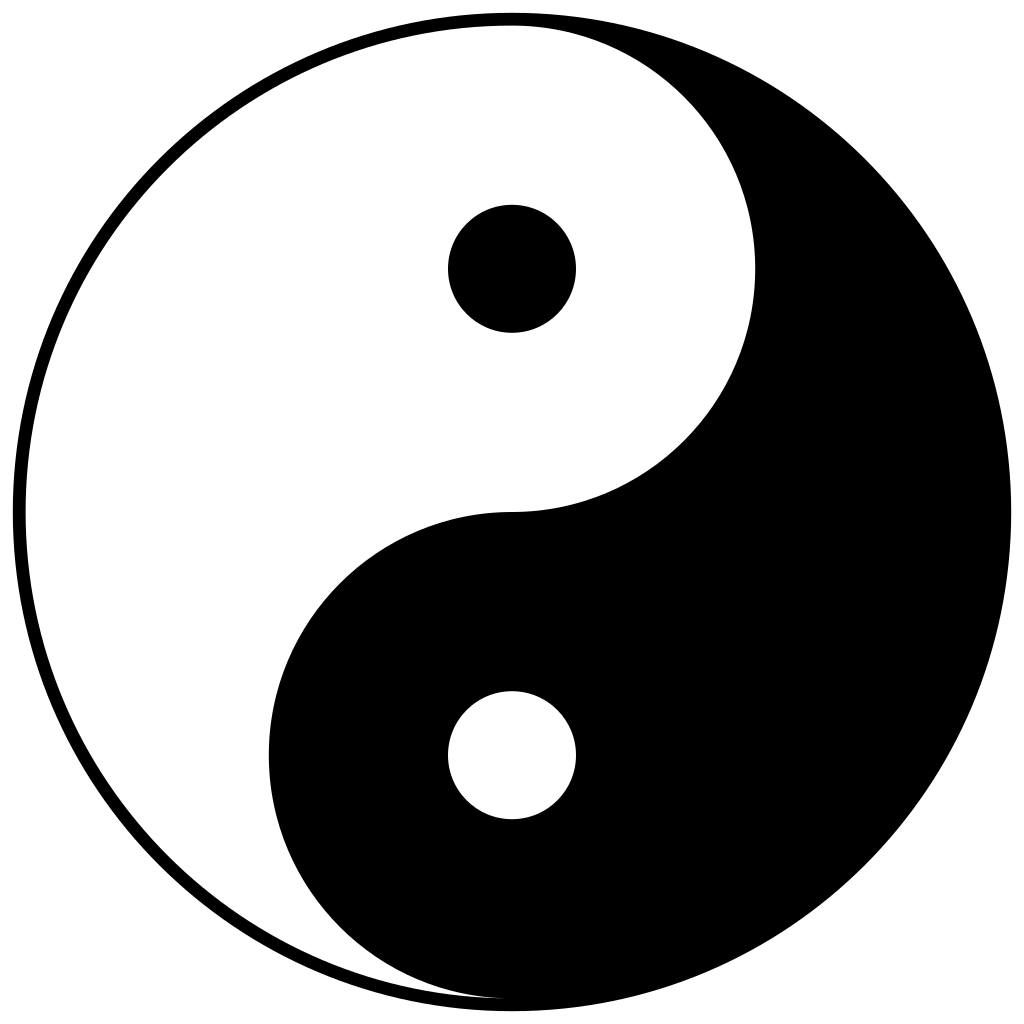
Yin is represented by the black color and corresponds to the feminine essence of things. It also stands for the earth, winter, smoothness, slowness, night, silence, the student, the son, mourning, compression…
Yang is represented by the white color and represents the masculine, the sky, summer, power, speed, day, speech, master, father, birth, expansion…
Yin and Yang are not energy itself, but are more philosophical concepts and practical life aspects that receive, contain and transmit the energy. These two aspects of the universe are complementary and always work together. There cannot be Yin without Yang and vice versa. They are both equal and one is not superior to the other.
The same concepts exist in the traditional Vedic culture and are largely taught through Yoga. They are called Tama (Yin) and Raja (Yang). Vedic sages added to these two sides a third concept called Sattva which represents a perfect balance between the two previous ones. Some types of Yoga practices and exercises are more Raja, others are more Tama, and the master may use both to rebalance a student’s physiology and psychology. And our final goal through the practice of Yoga is to tend towards a more Sattvic life in all its areas, physical, mental, health and spiritual, and where we step out of duality to discover that everything is one and embrace this wholeness.
In Karate, we traditionally have 3 components in training: Kihon, Kata and Kumite. To these I will add mental and physical conditioning.
So in all these areas of training, we must build a balance between the Yin and Yang sides of the practice: low or high speed motions, level of engagement (for example in Kumite), soft or powerful, strength and flexibility, endurance intensity, technical practice (Kihon and Kata) and sparring (Kumite)…
Of course this balance is highly personal and must be adapted to your own objectives and training needs (current imbalances, desires, constitutions…), but to be fully effective your training must always contain both sides of Taijitu. For most, it’s important to wisely balance the Yin and Yang aspects to build a comprehensive, uplifting and fulfilling practice that will become a great tool to support you in your everyday life, fostering your well-being and happiness, your health and fitness, your autonomy, your mental power and of course your ability to protect yourself - in the broad sense - and your loved ones.
“Ok, that’s cool, but concretely, how do I find my own balance?”
From Philosophy to Practice: Your 10-Step Blueprint
Understanding the dance of Yin and Yang is the foundation. But how do you stop the “hamster wheel” and actually build this balance in a life full of demands?
I have distilled 20 years of struggle, research, and Japan-acquired wisdom into 10 fundamental steps. These are the exact rules I use today to keep my center as a father, an entrepreneur, and a Karate-ka. They are designed to move you out of the “average zone” and into a life of high-energy fulfillment.
